Art and Activism: A Conversation with Sandy Williams IV and Tracey L. Meares, moderated by Dean Kymberly Pinder
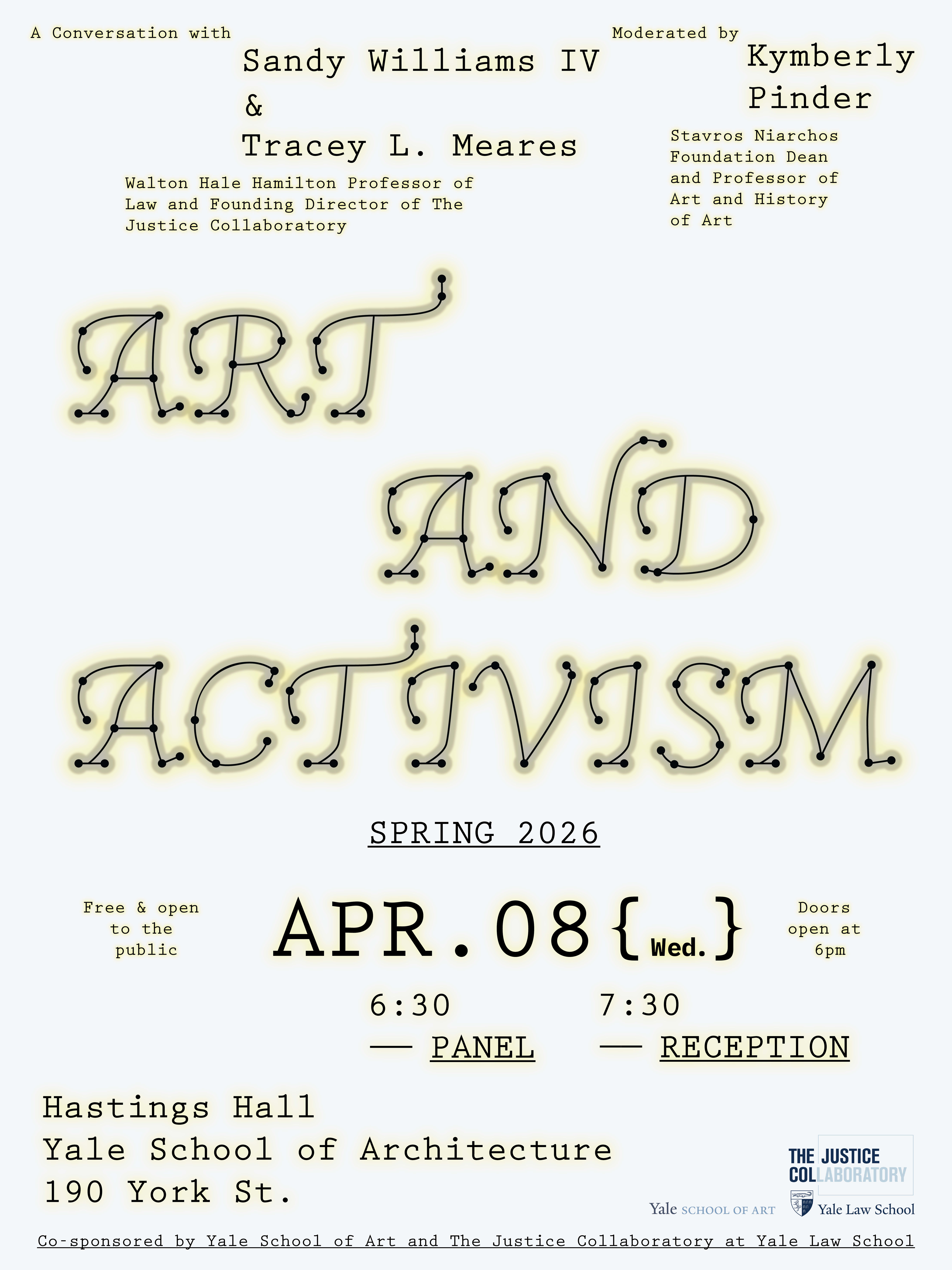
Wednesday, April 8
6:30PM
Hastings Hall, Yale School of Architecture, 190 York St.
Free & open to the public; doors open at 6pm, reception at 7:30pm
Interdisciplinary artist, filmmaker and professor, Sandy Williams IV, will be in conversation with legal scholar and professor at Yale Law School, Tracey L. Meares, and Dean of the Yale School of Art and scholar of race, representation, and public art, Kymberly Pinder. Together, our panelists will discuss the power of art as a catalyst for social change and the legal, social, and political landscapes surrounding art and activism in 2026.
Co-sponsored by Yale School of Art and The Justice Collaboratory at Yale Law School. This event is generously made possible by the Hayden Fund for Art and Ideas.
Poster design by Ningxin Yao, Graphic Design MFA '27.
***
Sandy Williams IV makes work about time: monuments, sculptures, films, and poems. Raised in the US south, their research-based practice studies the physical dimensions of abstract time through the lens of a Black radical imagination. Their projects blend moments of communal catharsis with live, shared experiences, to highlight the layers of historical presence that structure our everyday lives.
Williams is an Assistant Professor of Art at the University of Richmond. Recipient of the 2024 Joan Mitchell Fellowship, the Virginia Museum of Fine Arts Fellowship, and the New York Community Trust Van Lier Fellowship. Their work has been featured in The New York Times, New York Magazine, The Washington Post, Hyperallergic, and BBC. Permanent installations at Roanoke College and the University of Richmond. Artist in Residence at McDowell, MASS MoCA, Atlantic Center for the Arts, SOMA, ACRE, and the University of Cumbria. Exhibitions at MOCA Virginia Beach, Arlington MOCA, The Harnett Museum, ICA VCU, The Shed, Socrates Sculpture Park, and Grounds For Sculpture.
“My mother is an amazing cook, and when I think about all the meals that she made for our family over the years, I mostly remember how loved they made me feel. Through my family, especially my mother, I was introduced to making as an act of care. I want my art to hold people and our stories like my mother’s food.”
Tracey L. Meares is the Walton Hale Hamilton Professor and a Founding Director of the Justice Collaboratory at Yale Law School. Before joining the faculty at Yale, she was a professor at the University of Chicago Law School from 1995 to 2007, serving as Max Pam Professor and Director of the Center for Studies in Criminal Justice. She was the first African American woman to be granted tenure at both law schools.
Professor Meares is a nationally recognized expert on policing in urban communities. Her research focuses on understanding how members of the public think about their relationship(s) with legal authorities such as police, prosecutors and judges. She teaches courses on criminal procedure, criminal law, and policy and she has worked extensively with the federal government having served on the National Academy of Sciences Committee on Law and Justice, a National Research Council standing committee and the U.S. Department of Justice, Office of Justice Programs Science Advisory Board.
In April 2019, Professor Meares was elected as a member to the American Academy of Arts and Sciences. In December 2014, President Obama named her as a member of his Task Force on 21st Century Policing. She has a B.S. in general engineering from the University of Illinois and a J.D. from the University of Chicago Law School.
Dr. Kymberly Pinder (she/her) is the Stavros Niarchos Foundation Dean of the Yale School of Art. An alumna of Yale’s History of Art program, Dr. Pinder is an internationally recognized scholar of race, representation, and public art. She is the author of Painting the Gospel: Black Public Art and Religion in Chicago and the editor of Race-ing Art History: Critical Readings in Race and Art History.
Dr. Pinder is widely known for her deep commitment to education and its potential to address local and national challenges. In addition to being an eminent scholar and educator, she has extensive experience at institutions of higher education and museums.
Dr. Pinder was appointed Yale’s first Black woman dean in 2021. Prior to her appointment at Yale, she served as Provost and Senior Vice President, then later Acting President of Massachusetts College of Art and Design (MassArt). Before her time in Boston, she was the Dean of the University of New Mexico College of Fine Arts for six years, director and curator of the University of New Mexico Art Museum, chair of the Department of Art History, Theory and Criticism, and director of that department’s graduate program at the School of the Art Institute in Chicago (SAIC). Dr. Pinder has also worked in museums and galleries, such as the Metropolitan Museum of Art and The Art Institute of Chicago. Dr. Pinder received her M.A., M.Phil. and Ph.D. from Yale University.
Dr. Pinder has approached each of her leadership roles with the view that institutions of higher education must work closely with their home cities to advocate for the importance of arts and culture and to create reciprocal avenues of access. She has curated exhibitions on urgent contemporary issues and held forums for thoughtful student and community member dialogue. Working with local artists, schools and governments, she has helped create murals in Chicago, Albuquerque, and New Haven. Dr. Pinder serves on the boards of Association of Independent Colleges of Art & Design (AICAD), the photography organization CENTER, the Strategic National Arts Alumni Project, and the Boston Public Art Triennial. She also served on the Boston Art Commission.
Her work has been recognized and supported by the Terra Foundation, the Ford Foundation, and the National Endowment for the Humanities. And she was recognized as one of the Fifty Most Influential People of Color in Massachusetts Higher Education in 2021 and with the Albuquerque Business First 2018 Women of Influence Award in 2018.